

Table of Contents
Navigating the NDIS ecosystem in 2026 requires more than a basic understanding of line items; it requires a strategic approach to “Home and Living” supports. For participants and families across Melbourne, the transition between permanent living arrangements or the need for a restorative break often hinges on two critical supports: Short Term Accommodation (STA) and Medium-Term Accommodation (MTA).
At Care Compatible, we recognize that these aren’t merely “placements.” They are pivotal opportunities to build capacity, mitigate carer fatigue, and ensure safety during life transitional phases. As we look at the 2026 landscape, particularly within the growing hubs of Melbourne’s northern suburbs, the demand for high-quality, clinical-grade respite has never been higher.
This guide offers an authoritative in-depth examination of the workings of STA and MTA, the changing regulatory requirements of 2026, and how to capitalize on community-based stays in places such as South Morang to meet the long-term plan objectives.
1. Defining the 2026 Standard: Short Term Accommodation (STA)
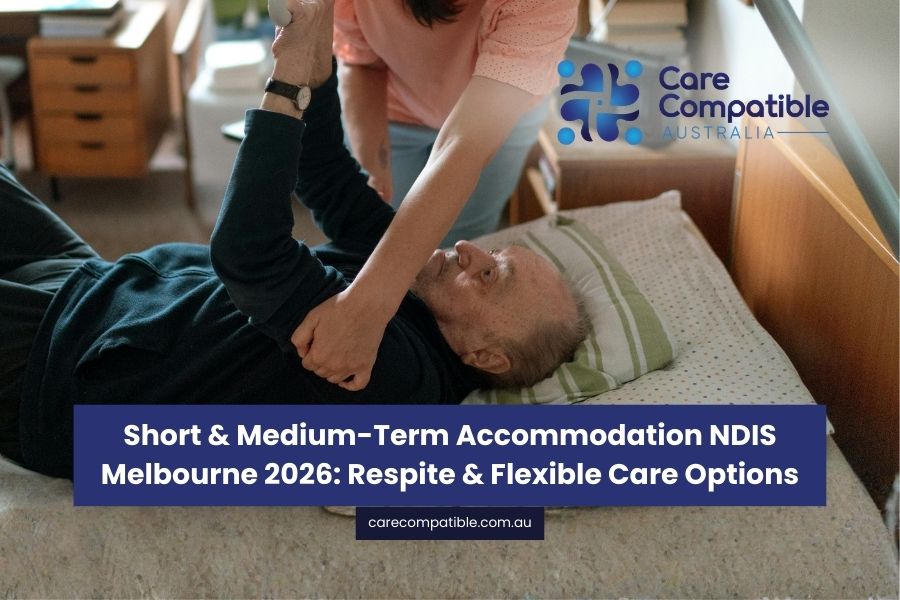
The term “respite” has undergone significant evolution. In the current NDIS framework, short term accommodation in NDIS Melbourne is categorized under Assistance with Daily Life. It is no longer viewed as a passive, “babysitting” service but as an active, goal-oriented intervention designed to support the sustainability of a participant’s primary care network while fostering individual growth.
The All-Inclusive Nature of STA
An STA stay at Care Compatible is a comprehensive 24-hour support model. Under the 2026 Pricing Arrangements, an STA package is expected to be a “frictionless” experience. When you engage a premium provider, the daily rate (often referred to as a “24-hour price”) incorporates:
- Specialized Personal Care: Assistance with activities of daily living (ADLs), tailored specifically to the participant’s functional capacity and support needs.
- Accommodation in Purpose-Built Environments: Properties that are more than the basic accessibility systems (Livable Housing Australia gold or platinum) and provide comfort, modernity, and sensory-friendly environments.
- Clinical Nutrition: Comprehensive meal plans that consider the most complicated dietary needs and religious orientation and dysphagia (IDDSI standards).
- Social and Community involvement: This is integrated support to be a part of the local Melbourne landmarks so that the stay is as much a social as a physical objective.
Strategic Duration: The “14-Day” Framework
While the NDIS typically funds up to 28 days of STA per year for those who require it, the 2026 guidelines emphasize the importance of “Reasonable and Necessary” usage. Generally, stays are capped for 14 consecutive days.
Many participants strategically prefer to use it in smaller, more regular blocks, e.g. one weekend per month. This keeps a steady rest rhythm of the main support system, avoiding the so-called burnout peak that usually causes hospitalization or family disintegration.
2. Navigating Transitions: The Role of Medium-Term Accommodation (MTA)
In case STA is the rest, therefore, Medium-Term Accommodation (MTA) is the one who bridges. The shift to permanent disability housing is a complicated logistical issue in 2026 since the Melbourne property market is exceptionally tight.
Criteria for MTA Funding
MTA is specifically designed for participants who have a confirmed long-term housing solution but cannot move in yet. It is typically funded for up to 90 days. Common 2026 scenarios where Care Compatible facilitates MTA include:
- Home Modification Delays: The delay of complex structural work, including lift installations or the installation of entire wet-room bathroom conversions, to a first home.
- Hospital Discharge Transitions: A vital step for participants ready to leave clinical care (Step Down care) but whose permanent SIL (Supported Independent Living) or SDA (Specialist Disability Accommodation) vacancy is not yet active.
- New Build Timelines: Participants waiting for a specific SDA project in the northern suburbs to receive its final occupancy certificate and fire safety clearances.
Funding Nuance: Accommodation vs. Support
A common point of confusion in 2026 is that MTA funding covers the cost of the “bricks and mortar” only. It is effectively a rental subsidy. It is imperative that participants have their Core support hours aligned to cover personal care or temporary nursing care during this transitional period. Without a concurrent support plan, the accommodation alone cannot safely meet the participants’ needs.
3. Geographic Excellence: The Rise of the Northern Suburbs Hub
When selecting a provider for STA MTA to respite in the northern suburbs, location is a strategic variable. Care Compatible has focused on its presence in the North, specifically South Morang, Mill Park, and Epping, due to the region’s superior infrastructure and accessibility.
The South Morang Advantage
Participants of community stay in South Morang have access to more than a room; they are able to receive an ecosystem of support, which makes them truly feel part of the community.
- Accessible Transport Hubs: The nearness of the Mernda rail line and efficient bus transport will keep the participants in touch with the rest of the Melbourne region, including the CBD and sporting precincts.
- Accessibility to Tertiary Health Services: Having the Northern Hospital and other related specialist allied health clinics in Epping and South Morang, the medical peace of mind is integrated in each of the stays.
- Social Inclusion & Retail Therapy: Access to the Westfield Plenty Valley precinct allows for high-level community engagement in a safe, controlled manner—a core metric of NDIS success in 2026.
4. Clinical Rigour: Temporary Nursing Care in Respite
A significant gap in the Greater Melbourne respite market is the provision of care for participants with high-intensity or complex medical needs. You cannot compromise on clinical safety when looking for temporary nursing care.
High-Intensity Support Standards
In 2026, Care Compatible has elevated its staffing models to meet the “High Intensity” descriptors outlined by the NDIS Quality and Safeguards Commission. This includes clinical oversight for:
- Complex Bowel and Bladder Management: It needs to be well documented, fluid balance chart and strict observation of specialist health plans.
- Enteral (PEG) Feeding: The support staff are specially trained on clinical nutrition, operation of the pump and stoma hygiene.
- Ventilator and Tracheostomy Management: For participants who require constant monitoring and immediate response capability.
- Subcutaneous Injections & Medication Management: Oversight by Registered Nurses where required by the participant’s complex medication regime or brittle health status.
By integrating nursing-led protocols into a residential setting, we ensure that a respite stay is a safe environment, not just a social one.
5. The Economics of Respite: Carer Sustainability
From a strategic standpoint, the primary driver for short term accommodation NDIS Melbourne is often the preservation of the informal support network. Research throughout 2025 has shown that carer burnout remains a leading cause of premature entry into permanent residential aged care or high-cost crisis SIL arrangements.
Respite is an investment in long-term system stability.
- Crisis Prevention: Proactive respite reduces the likelihood of a “breakdown in care” that could result in expensive emergency hospital admissions or police intervention.
- Network Resilience: Allowing primary carers, often aging parents or partners, to attend to their own health, secondary employment, and sibling relationships.
- Participant Autonomy: Respite provides the participant with a controlled environment to test their skills outside the family home. This is a vital “steppingstone” toward the goal of Independent Living.
6. Understanding the 2026 NDIS Pricing & Compliance
The 2025-2026 NDIS Pricing Arrangements have introduced stricter reporting requirements for STA providers. It is no longer enough to provide a bed; providers must demonstrate how the stay assisted the participant in achieving their goals.
The Cost Breakdown
The rates for STA are tiered based on the staff-to-participant ratio:
- 1:1 Support: Necessary for participants with high behavioral needs or complex medical requirements.
- 1:2 or 1:3 Support: Ideal for participants who enjoy social interaction and have lower-intensity support needs.
Providers must also account for TTP (Total Taught Price) and the specific “Intensity” of the support. Read a quote in a clear and transparent manner and ensure it corresponds with the current NDIS Price Guide to prevent planning overspends or audit problems.
7. Strategic Planning: Securing Your Funding in 2026
To ensure STA or MTA is included in an NDIS plan, the evidence provided to the NDIA must be robust and specifically linked to the “Reasonable and Necessary” criteria.
The Documentation Checklist
When preparing for a plan review or requesting a “Change of Circumstances,” ensure you have the following evidence ready:
- A Detailed Provider Quote: A description of the 24-hour care model, meal planning, and the cost of activities.
- Impact Statements: Testimonials by the primary carers explaining the physical and emotional burden of the caring role and the danger the placement is in case of respite is not provided.
- Allied Health Evidence: Reports by Occupational Therapists or Psychologists indicating how a stay in short term accommodation in NDIS Melbourne will develop certain skills (e.g., social, or morning routines, or community navigation).
- Clinical Justification: If you require temporary nursing care, a letter from a specialist or GP is essential to justify the high-intensity funding line.
8. Why "Compatibility" is the Key to Success
The name Care Compatible was chosen because, in the disability sector, “near enough” is never “good enough.” Compatibility is the difference between a stressful stay and a transformative experience.
Matching Participants
We take a strategic approach to “matching” during group stays. We consider:
- Age and Interests: It is important to make sure that a 20-year-old does not have a 80-year-old who has very different social needs.
- Sensory Profiles: Pairing participants with comparable tolerance to noise and light.
- Support Profiles: Ensuring the staff on shift have the specific skill set required for every individual in the house.
Matching Staff
Our staff selection process for the northern suburbs focuses on “Soft Skills” as much as technical qualifications. We seek support workers that can establish rapport, sense of non-verbal communication, and take initiative to promote community participation.
9. Case Study: The 90-Day Transition in South Morang
Take the case of one of the participants, James, who was about to leave a rehabilitation hospital in Melbourne after he suffered a spinal injury. His permanent SDA apartment in Epping was still six weeks from completion.
By utilizing Medium Term Accommodation with Care Compatible in South Morang, James was able to:
- Leave the hospital environment early, reducing the risk of healthcare-associated infections.
- Receive temporary nursing care for wound management while in a home-like setting.
- Begin practicing his “daily flow” in a wheelchair-accessible community, visiting local shops and parks before his permanent move.
This transition was not just about a bed; it was a six-week intensive capacity-building program that ensured his permanent move was successful.
10. The Future of Flexible Care: Looking Toward 2027
As we look toward the next horizon, the NDIS is moving toward even more integrated “Home and Living” models. We anticipate a greater focus on “Individualised Living Options” (ILO) where respite plays a smaller but more frequent role.
The emphasis will remain on community-based stays. The days of large, 10-bed “respite centers” are over. The future belongs to 2 and 3-bedroom high-quality homes in vibrant suburbs like South Morang, where disability support is woven into the fabric of the neighborhood.
Conclusion
In 2026, “compatibility” is everything. Whether you are seeking a community-focused stay in the northern suburbs to broaden your horizons, or you require the clinical precision of temporary nursing care during a complex life transition, the choice of provider dictates the outcome.
At Care Compatible, we combine senior-level disability expertise with a human-centric approach to support. Our properties across Melbourne’s north are more than just houses, they are the foundation for your next chapter of independence.
Is it time to review your accommodation strategy? Let’s discuss how our STA and MTA solutions can align with your 2026 goals and provide the restorative break your family deserves.
Contact Care Compatible Today – Schedule Your Professional Respite Assessment
Melbourne NDIS FAQ (Authority Optimization)
How does the NDIS define “Reasonable and Necessary” for STA?
The NDIA assesses if the support helps the participant stay in the community, provides value for money, and supports the sustainability of the informal care being provided. It must be directly linked to the goals in the participant’s plan.
What is the maximum duration for MTA in 2026?
The standard limit is 90 days. Extensions can be granted by the NDIA if there is clear evidence of a delay in a confirmed long-term housing solution (e.g., building delays or equipment supply chain issues).
Can STA be used for “High-Intensity” clinical needs?
Yes. However, it must be billed under the correct “High Intensity” line item in the NDIS Price Guide. This ensures the provider can supply staff with the appropriate clinical training, such as Registered Nurses for temporary nursing care.
Are meals included in the STA daily rate?
Yes. Under the 2026 NDIS Pricing Arrangements, the Short-Term Accommodation rate is “all-inclusive,” covering the cost of the stay, all meals, and the support staff required for the duration of the booking.
Why is South Morang popular for NDIS respite?
South Morang offers a rare combination of high-spec accessible housing, proximity to major hospitals (The Northern), and a highly accessible community precinct (Westfield Plenty Valley), making it ideal for community participation goals.
